Home
Store
ALL
Mythology
Games Blog Contact

Gaia and Uranus: The Forbidden Union That Birthed the Titans
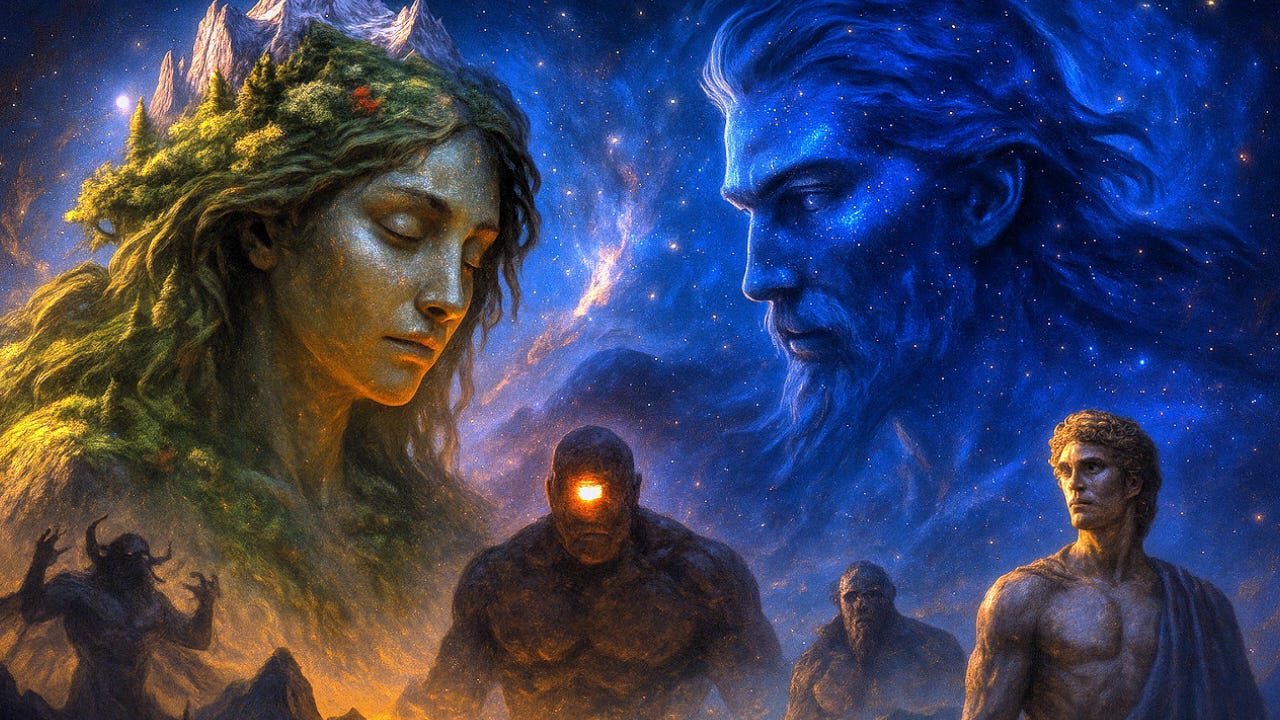
How earth first rose to meet the sky, and how the quiet between them learned to tremble.

Introduction

There are beginnings that arrive with noise, tearing the world open. And there are others that bloom in silence. The birth that joined Gaia and Uranos belongs to the second kind. Before their meeting, the cosmos was an expanse without edges, a hush left behind by Chaos. No horizon. No sky. Only a drifting stillness that felt less like peace and more like a question.

From that quiet, Gaia emerged. Not as a figure walking into light, but as a vast, breathing presence of stone and soil, emerald coastlines and deep currents waiting under unbroken crust. She carried her mountains like thoughts rising to the surface. Beneath her, Pontus slept in dark water, still unshaped, still dreaming of tides that had never existed.

Gaia was powerful. Complete. But even creation has its lonelier corners, and she felt them all. Above her stretched nothing. A void so empty it pressed against her like a forgotten sky. Desire, in its earliest form, stirred.

And the universe answered.

I. When Earth First Gazed Upward

The surface of Gaia glowed with shifting greens, veins of dormant rivers tracing faint lines under her skin. She rose in slow breaths, as if testing the shape of her own existence. The Ourea stood around her as monuments of solitude, their peaks cold and watchful.

Yet none of it filled the distance overhead. The silence above was too wide. Too still. Gaia sensed a horizon that could be more than emptiness, and that longing curled through her like a low tide returning.

It wasn’t a wish for company. It was something deeper: the need for balance. Earth reaching upward, waiting for something vast enough to meet her.

The void waited with her, though neither knew it.

II. The Sky Takes Form

Light appeared first. Not a burst, not a star, but a silver mist collecting in soft spirals. It drifted and folded, gathering along invisible lines as if the void already held a map for what was coming.

Threads of radiance wove themselves into a canopy. Stars kindled across its surface, one by one, until the dark was no longer empty but studded with points that pulsed with quiet life.

Uranos rose from this gathering glow. A vault of constellations. A shape without edges. A presence large enough to crown the world beneath him. His light washed across Gaia’s slopes, tracing ancient grooves and forgotten hues, revealing that she had never been as still as she seemed.

Winds formed from his breath and raced across her plains. Rivers shifted beneath her crust. The first shadows appeared, soft and uncertain, cast by a sky that had never existed before.

No words passed between them. They didn’t need them.

Earth had found her sky. Sky had found something solid enough to hold his light.

III. The Space Between Them Trembles

There is a moment before union when two forces, perfectly matched, hesitate. Not out of fear, but out of recognition. Gaia and Uranos lingered in that thin, trembling pause.

Uranos lowered himself in sweeping arcs, his starlit form folding in gentle descent. Constellations rippled across him like living patterns. His radiance brushed the peaks of the Ourea, and the mountains shivered, uncertain whether to grow taller or bow.

Gaia responded with motion of her own. Rivers glimmered. Flowers broke open without sound. Currents stirred deep in the places where Pontus slept. The entire world seemed to rise in one slow breath.

Still they did not touch.

In the air between them, a charge built. A thread of luminous energy stretching from the highest mountain to the lowest star. Creation often begins this way, not with impact, but with anticipation.

When they finally converged, the cosmos did not thunder. Instead, everything held still. The first Hierogamy unfolded in silence, a union written in light and stone.

From that meeting came a rhythm so ancient it still pulses in the tides and the mountains.

IV. Titans in a Newborn World

Creation rarely ends with its first spark. Often it awakens something larger, deeper, more demanding.

Gaia stirred with renewed vitality. Light raced beneath her surface in currents that felt almost like thought. And from those currents came shapes. Great shapes. Twelve in all.

Oceanus, flowing with the breadth of every river yet to come.
Coeus, whose eyes mapped stars even before they had names.
Hyperion, blazing like the promise of dawn.
Crius, anchored like a pillar holding up the shifting world.
Theia, shimmering with a beauty that revealed hidden truths.
Rhea, blooming with quiet abundance.
Themis, steady as law itself taking its first breath.
Mnemosyne, weaving memory through silence.
Phoebe, glowing with pale wisdom.
Tethys, moving like the tide before it learned its cycles.
Iapetus, carrying fate in the weight of his hands.
And last, Cronos, lean and still, his presence sharp as a horizon waiting to be broken.

They did not speak. They simply existed, and their existence reshaped the world.

But creation has a shadow, and it rarely waits long.

V. Forces Born of Fire and Disorder

Deep beneath Gaia’s surface, new beings stirred. Not Titans. Not gentle forces. Something else.

Three shapes coiled in darkness, each crowned with a single blazing eye. Brontes. Steropes. Arges. They radiated fire and storm, lightning and molten strength. Where the Titans carried balance, the Cyclopes carried raw, ungoverned power.

And deeper still, in chambers untouched by light, another trio thrashed into being. The Hecatoncheires. Cottus with his restless arms, Briareus with his mountain-breaking force, and Gyges whose motions could split the air itself. They were not graceful. They were not meant to be. They were chaos shaped into bodies too vast to ignore.

Gaia felt all of them forming. Her power was great enough to bear them, but even she trembled at their arrival.

Uranos trembled too. But not in awe.

His silence changed. His light dimmed around the edges. A new feeling flickered across the vault of heaven. Something sharp, something cold.

Judgment.

VI. When the Sky Begins to Fear the Earth

At first, Uranos watched his children with the wonder of a creator. But wonder can sour when power grows beyond expectation.

The Titans stretched across the land, shaping valleys, stirring currents, casting new rhythms through every corner of the world. Their forms grew stronger, bolder. They were no longer the soft glow of beginnings. They were forces.

And Uranos saw it.

He saw Hyperion’s fire spreading too far. Oceanus carving paths too wide. Themis standing unmoved by the sky’s shifting moods. Cronos, the youngest, watching him with a gaze that did not lower.

A distance settled over the heavens. A thin layer of silence. Not the peaceful kind. The other kind.

Uranos hovered higher. His light pressed downward instead of illuminating. His embrace tightened into something heavy. The sky became a vault, not a partner.

Gaia felt the change before she could name it. Valleys sank under invisible weight. Mountains trembled without wind. Even the tides of Thalassa faltered, rising in confusion before withdrawing again.

Creation had turned. Not toward destruction, not yet, but toward strain.

The cosmos held its breath.

Conclusion

The union of Gaia and Uranos shaped the first order of existence. Mountains rose to meet constellations. Seas whispered to stars. Titans walked a world still warm from creation’s touch. Yet beneath all that wonder, a quiet tension grew. The sky watched the earth with eyes no longer softened by awe. The earth carried children the heavens feared to claim. And somewhere in the shadows beneath stone and starlight, the first tremor of defiance took root.

This is only the beginning. The next chapter belongs to the fall of Uranos, where love turns to chains and chains turn to catastrophe.

Until then, watch the sky with care.

🎬 VIDEO

S1•E2 | Definitive Greek Mythology Series
🎧 PODCAST

S1•E2 | Definitive Greek Mythology Series

When the First Stories Tried to Explain the World

A creation that never fit into a single voice.

Introduction

Some stories arrive like a straight line. Others wander the dark before they decide where to begin.
The Greeks never settled for one version of how the world started. They let the beginning stay a little blurry, as if creation itself kept turning its face away, refusing to be caught by a single torch.

Before gods learned their names and before the sky leaned over the earth, there was a question hanging in the air. Not a written question. A question that lived in the way shadows moved, in the way silence sometimes seemed to breathe. What stood before everything else? What rose first from the dark?

Different voices answered. None canceled the others.
Hesiod spoke as if he were arranging stones on a path.
The Orphic poets sang as if creation were a secret whispered inside a ritual.
The first philosophers stepped back and watched, trying to find something beneath the story.

If you listen long enough, you hear all of them overlapping.
The beginning of the world was not one tale.
It was a chorus.

I. Hesiod and the Order Carved from the Dark

Hesiod starts his journey with a single presence. Chaos.
Not a monster. Not a storm. A gap. A wide, quiet opening from which everything wrong-footedly pushes itself forward. He never calls it empty. He never calls it full. Only first.

From that stillness came shapes that did not wait for permission. Gaia rising like a continent gathering weight. Tartarus deepening below her until even light seemed to hesitate. Eros slipping into the scene as something that binds rather than breaks.

One breath after another, the cosmos began to thicken. Gaia stirred again and created Uranus without needing touch or companion. From their union the Titans stepped forward, heavy with the echo of a world still learning how to stand. The Cyclopes blinked their single eyes at the new brightness. The Hecatoncheires rumbled with too many arms and too little patience.

And somewhere behind it all, a sense of succession already waited.
Uranus would fall. Cronus would rise. Zeus would burn his mark into the sky.
The pattern felt inevitable, like thunder rehearsing before the storm.

II. The Orphic Whisper Behind the World

But not everyone saw the beginning standing on those legs.
The Orphic poets preferred the world in a different light. Softer. Stranger. Less eager to explain itself.

For them, the first pulse was not Chaos. It was Time. Cronos, ancient and coiled, moving in slow circles that pressed the dark into shape. Or sometimes it was Night herself, heavy with secrets, folding the cosmos inside her wings.

From that pressure came an egg.
A single shell holding everything unformed.

The crack of that egg was the first dawn.
Phanes burst forward in a radiance that did not warm so much as reveal. Shimmering, androgynous, almost too bright to look at without blinking. He was not builder or warrior. He was awareness given flame, a mind at the edge of the void.

Zeus would later swallow this light in some versions, carrying creation inside his own body to rebuild it again. Not out of hunger. Out of necessity. Out of the strange logic that myths sometimes follow when they try to explain power.

The Orphic story does not shout. It murmurs.
It turns creation into something closer to memory than record.
A truth you feel before you understand.

III. When Thought Tried to Replace Story

Then came the ones who wanted to step outside the myth without abandoning it. The first philosophers. They looked for the shape behind the shape.

Thales imagined that everything began with water. Not the sea as a god. The sea as a fact. A slow recognition that life reflects whatever sustains it.
Anaximander pointed to something larger, something without edge or face. The apeiron. The boundless. Not Chaos as Hesiod framed it, but a cousin stripped of divine breath. A source that refused personality.

They were not denying the stories. They were turning them sideways, testing how the world might look if you removed the voices of gods. And yet, even their theories hover close to the old tales. Water is still Oceanus in another tongue. The boundless is still Chaos spoken differently.

It is hard to erase the divine when the divine has already shaped the language.

IV. The Many Small Beginnings Hidden Across Greece

Beyond the poets and philosophers, Greece itself kept inventing new openings.
Athens told of people rising directly from the ground, children of Gaia, as if the soil refused to release them until the right moment.
Other cities traced their origins to rivers or hills or even to a sudden breath from the wind.

These stories did not aim to explain the cosmos.
They tried to explain belonging.
Every place wanted a root older than memory.

And when Rome inherited the Greek skeleton of myth, it carved its own order into it. Jupiter, Neptune and Pluto dividing the world like brothers who had agreed to stop arguing, at least long enough to draw lines on a map.

Creation is never one tale. It mutates, curls around new fears, absorbs new hopes, and shifts with every border drawn across the land.

V. What All These Voices Share

If you stand back far enough, something quiet connects all these beginnings.
A sense that the world did not start clean.
It rose through resistance. Through pressure. Through a darkness that was not enemy, but womb.

Hesiod gives the world shape.
The Orphics give it pulse.
The philosophers give it distance.

None of them fully agree.
But none of them can resist the urge to describe how the first spark found its way into the open.

Creation, in every version, is an attempt to name the moment before the moment.

Conclusion

There are things these stories reveal more clearly when seen rather than read. The episode for this week explores the movements behind each version, letting the myths breathe in sound and image.

🎬 VIDEO

S01•E01 | Definitive Greek Mythology Series

🎧 PODCAST

S01•E01 | Definitive Greek Mythology Series

Chaos: Where Silence Learned to Breathe

Before stories chose a shape, something older waited in the dark.

Introduction

There are beginnings that refuse to appear tidy. They come not with light, but with a sort of trembling hush, as if the world is still unsure whether it should exist at all. The Greeks tried to name that feeling. They called it Chaos. Not destruction. Not confusion. Something more primitive. A space that could hold everything because it was nothing yet.

Imagine a darkness that isn’t empty. A darkness that listens. You can almost sense a slow pulse beneath it, like a drum muffled under layers of night. Nothing moves at first. Then the quiet shifts, just a little, as though creation inhales for the first time.

The old poets placed their faith in this moment. Before mountains, before light, before even the thought of time, there was this living void. And from it, forms began to stir. Not orderly. Not all at once. They rose the way ideas sometimes rise in the mind when the room is completely still.

This is the world before the world, and it begins with silence learning how to breathe.

I. The Breath of the Void

Chaos did not stand for darkness alone. If anything, it refused to be defined so simply. It felt more like a vast room without walls, a place that held both promise and unease. Some ancient voices said it was a yawning gap. Others imagined it as a womb of shadows. Either way, nothing in it rested. Wisps of possibility drifted through the gloom, brushing against each other like thoughts passing in a half-dream.

In that restless quiet, something waited to take shape. The poets insist Chaos came first, not as a god, not as a figure, but as the raw potential beneath anything that might dare to exist. You can almost hear a heartbeat there, slow and irregular, the kind that suggests a beginning rather than a life already defined.

It is strange to think the cosmos began in a place so unformed, but perhaps every story does. A blank page is never truly blank.

II. Gaia Finds Her Shape

From that formless depth, the first certainty rose. Gaia. Solid, patient, immense. She didn’t burst from Chaos as much as she settled into being, like soil hardening after long rain. Her presence pushed back the drifting shadows, giving them edges they had never known.

Hills curved gently from her body. Peaks clawed upward. Ridges spread like ribs bracing the world. She felt ancient the moment she appeared, as if she had been dreaming long before she woke. Rivers ran along imagined paths, and valleys opened where her breath might have fallen.

Gaia was not just earth. She was the comfort of definition, the first moment the cosmos could point to something and say here. In a realm made of maybe, she became the first yes.

III. Beneath the Surface, a Deeper Shadow

But creation rarely arrives without its echo. If Gaia offered form, Tartarus offered depth. Somewhere below her roots, a darker presence stirred. Not evil. Simply older in a different way. Tartarus was a hollow so profound it seemed to swallow sound before it existed.

Its walls were jagged, ancient, and far from empty. A strange pressure lived there, the kind that reminds you the world has places best left unlit. While Gaia opened space upward, Tartarus opened it downward, and between the two, a strange balance took hold. Form above. Abyss below. Neither canceling the other.

The cosmos was already learning that creation requires both light and its shadow.

IV. Sparks, Night, and the First Traces of Order

No world can grow on stillness alone. Something needed to bind all these drifting beginnings. In that unsettled quiet, a glimmer appeared. Eros. Not the mischievous child of later myths, but a pulse of connection itself. A warmth threading between Gaia’s certainty and Chaos’s open dark. He didn’t build mountains or forge seas, but he pushed things toward each other, coaxing unity from the scattered dust.

Yet even with his touch, the void kept its mysteries. From the edges of Chaos rose Erebus, a shadow with weight enough to anchor the growing world. And beside him moved Nyx, her presence soft but commanding, a night so rich it felt woven rather than fallen. She walked through the newborn cosmos with a calm that made the darkness less frightening, though never safe.

Their children, Aether and Hemera, answered them in light. Not harsh light. A gentle shimmer. A glow that hinted at dawn long before dawn had meaning. Night and day were not yet cycles, but the pieces of a rhythm were gathering.

Slowly, the cosmos stopped feeling like a dream and began to resemble a place.

V. Time Coils, Light Breaks, and the World Learns to Divide Itself

Elsewhere in the swirling dark, a different tradition imagined time itself taking shape. A serpent of shimmering coils, older than even Chaos, twisted through the void. Chronos. Around him moved Ananke, stern and steady, the pressure that turns drifting ideas into structure.

Together they compressed the vastness into something tighter, something waiting to burst. From their turning arose the cosmic egg, gleaming with hidden color. Inside it, light pressed against darkness until the shell cracked. Phanes emerged. Radiant. Knowing. His arrival illuminated what had been only imagined, and with his light the cosmos began choosing its form.

Gaia grew mountains. The sea stirred as Pontos rose. Even the gentler tide, Thalassa, shimmered along the new shores. From above, Aether glowed. Below, Tartarus brooded. Between them, Chaos no longer felt dominant. It had become the quiet undercurrent rather than the whole of existence.

But it did not disappear. It waited in the spaces between stars, patient as ever.

VI. When Stories Begin to Recognize Themselves

Other voices remembered creation differently. They spoke of Eurynome rising from endless waters, her dance shaping the currents into meaning. Ophion, the serpent, spiraled around her, their steps churning the void into motion. Their egg opened, spilling sky and sea, day and night, into the world.

Strange how these tales, though distinct, echo one another. A goddess shaping form. A serpent winding fate. Light breaking from confinement. Perhaps the Greeks believed that creation needed more than one explanation because no single story could carry the weight of beginnings alone.

What matters is that the world took root. Shadows found places to settle. Light discovered where to fall. And Chaos, once the entire stage, became the quiet backdrop behind every story yet to unfold.

Conclusion

There are things in this tale that only make sense when seen in motion. The video for this episode walks through the shapes and sounds that words can only hint at, while the podcast lingers on the atmosphere behind each scene.

🎬 VIDEO

S01•E01 | Definitive Greek Mythology Series

🎧 PODCAST

S01•E01 | Definitive Greek Mythology Series