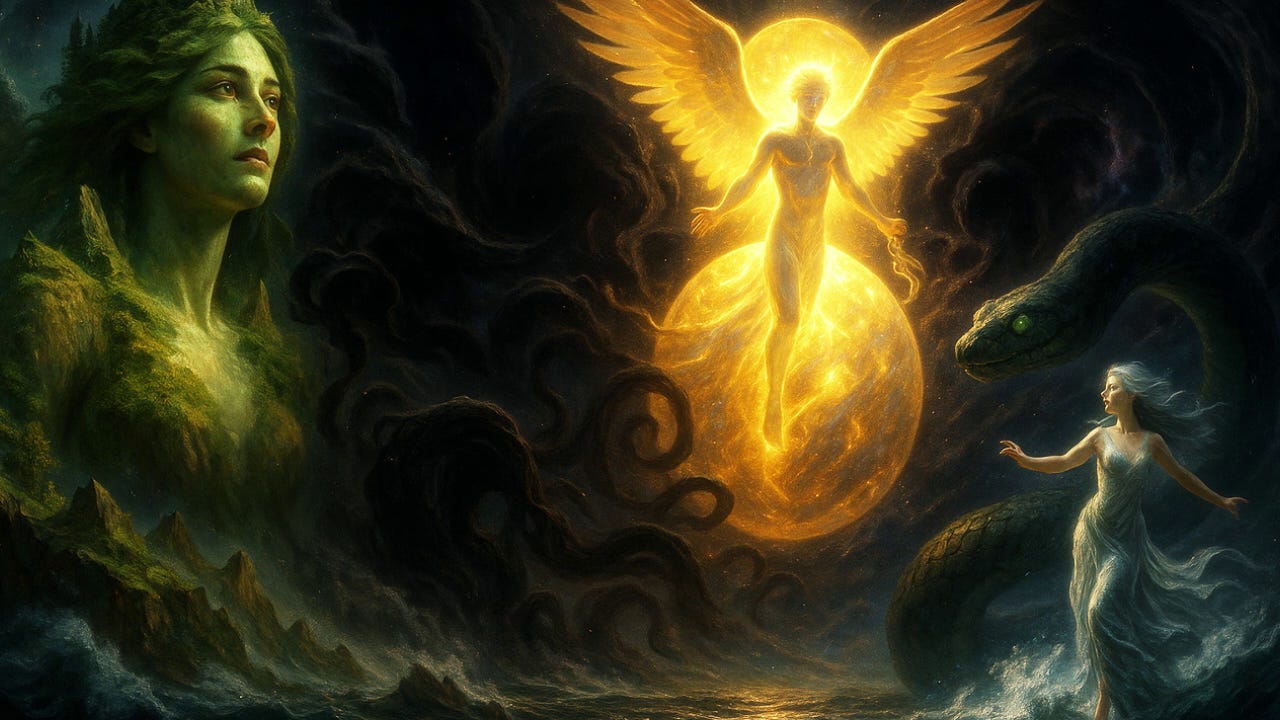
A creation that never fit into a single voice.
Introduction
Some stories arrive like a straight line. Others wander the dark before they decide where to begin.
The Greeks never settled for one version of how the world started. They let the beginning stay a little blurry, as if creation itself kept turning its face away, refusing to be caught by a single torch.
Before gods learned their names and before the sky leaned over the earth, there was a question hanging in the air. Not a written question. A question that lived in the way shadows moved, in the way silence sometimes seemed to breathe. What stood before everything else? What rose first from the dark?
Different voices answered. None canceled the others.
Hesiod spoke as if he were arranging stones on a path.
The Orphic poets sang as if creation were a secret whispered inside a ritual.
The first philosophers stepped back and watched, trying to find something beneath the story.
If you listen long enough, you hear all of them overlapping.
The beginning of the world was not one tale.
It was a chorus.
I. Hesiod and the Order Carved from the Dark
Hesiod starts his journey with a single presence. Chaos.
Not a monster. Not a storm. A gap. A wide, quiet opening from which everything wrong-footedly pushes itself forward. He never calls it empty. He never calls it full. Only first.
From that stillness came shapes that did not wait for permission. Gaia rising like a continent gathering weight. Tartarus deepening below her until even light seemed to hesitate. Eros slipping into the scene as something that binds rather than breaks.
One breath after another, the cosmos began to thicken. Gaia stirred again and created Uranus without needing touch or companion. From their union the Titans stepped forward, heavy with the echo of a world still learning how to stand. The Cyclopes blinked their single eyes at the new brightness. The Hecatoncheires rumbled with too many arms and too little patience.
And somewhere behind it all, a sense of succession already waited.
Uranus would fall. Cronus would rise. Zeus would burn his mark into the sky.
The pattern felt inevitable, like thunder rehearsing before the storm.
II. The Orphic Whisper Behind the World
But not everyone saw the beginning standing on those legs.
The Orphic poets preferred the world in a different light. Softer. Stranger. Less eager to explain itself.
For them, the first pulse was not Chaos. It was Time. Cronos, ancient and coiled, moving in slow circles that pressed the dark into shape. Or sometimes it was Night herself, heavy with secrets, folding the cosmos inside her wings.
From that pressure came an egg.
A single shell holding everything unformed.
The crack of that egg was the first dawn.
Phanes burst forward in a radiance that did not warm so much as reveal. Shimmering, androgynous, almost too bright to look at without blinking. He was not builder or warrior. He was awareness given flame, a mind at the edge of the void.
Zeus would later swallow this light in some versions, carrying creation inside his own body to rebuild it again. Not out of hunger. Out of necessity. Out of the strange logic that myths sometimes follow when they try to explain power.
The Orphic story does not shout. It murmurs.
It turns creation into something closer to memory than record.
A truth you feel before you understand.
III. When Thought Tried to Replace Story
Then came the ones who wanted to step outside the myth without abandoning it. The first philosophers. They looked for the shape behind the shape.
Thales imagined that everything began with water. Not the sea as a god. The sea as a fact. A slow recognition that life reflects whatever sustains it.
Anaximander pointed to something larger, something without edge or face. The apeiron. The boundless. Not Chaos as Hesiod framed it, but a cousin stripped of divine breath. A source that refused personality.
They were not denying the stories. They were turning them sideways, testing how the world might look if you removed the voices of gods. And yet, even their theories hover close to the old tales. Water is still Oceanus in another tongue. The boundless is still Chaos spoken differently.
It is hard to erase the divine when the divine has already shaped the language.
IV. The Many Small Beginnings Hidden Across Greece
Beyond the poets and philosophers, Greece itself kept inventing new openings.
Athens told of people rising directly from the ground, children of Gaia, as if the soil refused to release them until the right moment.
Other cities traced their origins to rivers or hills or even to a sudden breath from the wind.
These stories did not aim to explain the cosmos.
They tried to explain belonging.
Every place wanted a root older than memory.
And when Rome inherited the Greek skeleton of myth, it carved its own order into it. Jupiter, Neptune and Pluto dividing the world like brothers who had agreed to stop arguing, at least long enough to draw lines on a map.
Creation is never one tale. It mutates, curls around new fears, absorbs new hopes, and shifts with every border drawn across the land.
V. What All These Voices Share
If you stand back far enough, something quiet connects all these beginnings.
A sense that the world did not start clean.
It rose through resistance. Through pressure. Through a darkness that was not enemy, but womb.
Hesiod gives the world shape.
The Orphics give it pulse.
The philosophers give it distance.
None of them fully agree.
But none of them can resist the urge to describe how the first spark found its way into the open.
Creation, in every version, is an attempt to name the moment before the moment.
Conclusion
There are things these stories reveal more clearly when seen rather than read. The episode for this week explores the movements behind each version, letting the myths breathe in sound and image.
🎬 VIDEO
S1•E1 | Definitive Greek Mythology Series