S2•E1 | Definitive Greek Mythology Series
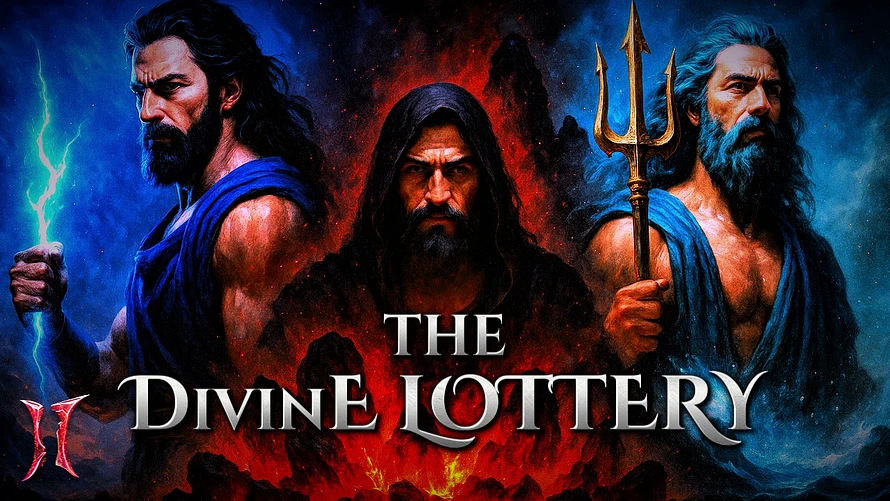
What comes after victory is rarely peace. Sometimes it is only the quieter beginning of a new kind of fear.
There is a strange stillness that arrives after violence. Not relief, exactly. More like a held breath.
That is where this story begins.
The Titans have fallen. Cronus is no longer devouring his children or ruling by dread from above the world. The thunder has already spoken. The mountains still carry the scars of that war, and the earth itself feels tired, as if it has survived something too vast to name. But overthrowing a tyrant is one thing. Deciding what comes next is another. Harder, maybe.
In Greek myth, power never settles easily. It moves. It changes hands. It inherits old wounds. So when Zeus and his siblings step into the silence left behind by the Titanomachy, they are not entering triumph. They are entering responsibility, and responsibility in myth is never clean. It comes tangled with memory, prophecy, envy, law, hunger.
This is one of the reasons the aftermath interests me almost more than the war itself. A battle can end with spectacle. Order has to be built in the quieter hours, when everyone is still carrying the smoke inside them.
A world that has to be named
The first gathering of the gods after the war does not feel like a coronation. It feels provisional, almost fragile. They meet not in a palace, but on open ground, surrounded by ash, stone, and the remains of what was broken. No throne dominates the scene. No one is enthroned yet in the full symbolic sense. That matters.
The old order has collapsed, but the new one has not fully taken shape. And in that suspended space, everything feels possible in the most dangerous way.
Zeus is there, of course, still young in a sense, though already marked by survival. Hades arrives like a thought no one can escape. Poseidon carries the sea with him. Hera, Demeter, and Hestia stand not as decorative presences but as survivors of the same violence, each shaped by having once been swallowed, erased, contained inside their father’s body. That detail never stops being horrifying. Greek myth often moves quickly over things that should stop us cold.
And maybe that is exactly why this council matters so much. The question before them is not simply who gets what. It is whether power can exist without becoming monstrous again.
That anxiety runs under everything.
The first order is not conquest, but agreement
One of the most striking things in this part of the myth is that the division of the cosmos is framed through restraint. Not through one sibling imposing a final claim by force, but through a process, a structure, a ritual. Themis enters the story here with immense gravity. She is not spectacle. She is balance.
That presence changes the texture of the scene. The conversation is no longer merely political. It becomes almost sacred.
And the gods seem to understand that what they are creating will outlast their moods. Hera, especially, comes into focus here in a way I love. She is not just future jealousy, not just future marriage drama, not just the stereotype mythology sometimes gets flattened into. She is thinking structurally. She wants legitimacy. Form. Law. A world where nobody becomes Cronus again.
Demeter, too, speaks from a different register. Not territory for the sake of domination, but land as something that must remain alive, shared, fertile. Her imagination is not imperial. It is sustaining. Hestia, quieter than the others, does something perhaps even more important. She lights the hearth.
That gesture changes the emotional center of the story. Suddenly the cosmos is not only being divided into domains of rule. It is being given a center of warmth. A home. A flame around which agreement becomes possible.
It is easy to miss how radical that is. The first stable thing in this new order is not a weapon. It is a fire meant to be kept.
Chance, fate, and the uneasy fairness of the draw
Then comes the drawing of lots, one of those mythic moments that feels both simple and immense.
Zeus, Poseidon, and Hades step forward. Three brothers. Three stones. Heaven, sea, underworld.
There is something almost unnerving about how much rests on a gesture this small. A hand entering a vessel. A symbol revealed. A realm assigned.
And yet that is precisely what gives it force. The division is not meant to flatter ambition. It is meant to prevent immediate fracture. No one can say the cosmos was seized unfairly in that instant, even if resentment will come later, and of course it will. This is Greek myth. Resentment is never late.
Zeus receives the sky and the visible world. Poseidon the sea. Hades the realm below, the unseen kingdom of the dead.
On paper, it sounds neat. In feeling, it is not neat at all.
Because each realm carries its own burden. Zeus gets height, exposure, judgment, atmosphere, the dangerous brilliance of being visible. Poseidon gets motion, instability, magnificence, depth without stillness. Hades gets what others would call the darkest inheritance, but he receives it with a seriousness that feels almost clarifying. He understands something the others do not fully say aloud: power is not diminished by being hidden.
What fascinates me here is that the draw resolves the dispute, but not the emotions. It creates order without eliminating tension. That feels true to myth, and honestly, true to life.
Hestia and the quiet refusal of spectacle
If there is a figure in this episode who lingers after the larger scenes fade, it is Hestia.
She does not seize attention. She does not hurl lightning or summon waves or descend into the earth to build a kingdom of the dead. She tends the flame, remains near the hearth, and gives up her place so that peace can hold. It is a refusal of spectacle, but not of power. That distinction matters.
There is a tendency, especially in modern retellings, to treat quieter divine figures as somehow less dramatic. But Hestia’s choice has an ache to it. She becomes the condition that allows everyone else to remain together. She steps back so the whole structure can breathe.
And around that absence, something uncanny appears: the empty throne.
Not abandoned. Waiting.
The mythic imagination is rarely content with a vacancy. An empty place becomes a promise. A prophecy. A pressure in the room. The throne wrapped in vines and light suggests that the divine order, even at its moment of apparent completion, is unfinished. Something ecstatic, disruptive, boundary-breaking is already on its way. No names need to be spoken yet. The silence says enough.
What I like here is that the future does not arrive as an interruption from outside. It is already present inside the architecture of order itself.
No peace in myth is ever innocent
By the time laws are spoken, oaths sealed by Styx, seasons fixed by the Hours, and fate rewoven by the Moirai, the world seems, at least from a distance, steadier. The machinery of divine existence begins to turn properly. Time aligns with destiny. Ritual appears. Boundaries are named. Roles are accepted.
But the story is too honest to pretend that law erases appetite.
Poseidon already feels the sting of comparison. Hades accepts his realm with composure, but not passivity. Hera watches, measuring what this new order will demand of her. Demeter senses losses not yet visible. Zeus, even at the threshold of kingship, cannot escape the oldest fear in Greek myth: that every ruler eventually becomes haunted by the child who may replace him.
That thread is one of the darkest in the whole tradition. Uranus fears succession. Cronus fears succession. Zeus is warned that he, too, may one day face the same pattern. And suddenly the victory over the Titans looks less like an ending than an interruption in a family curse.
Meanwhile Gaia is quiet, which in myth is rarely reassuring. The earth remembers. The earth waits. A silence beneath the order has not been healed, only covered for a while.
That, more than anything, gives this chapter its pulse. The world has been divided, yes. But division is not peace. Structure is not trust. Law is not the same thing as reconciliation.
And maybe the Greeks knew that better than most.
The fragile beginning of a new order
What stays with me after this episode is not the grandeur, though there is plenty of that. It is the uncertainty humming under the grandeur. The sense that the gods themselves know they are building on unstable ground.
A sky can be claimed. A sea can be ruled. An underworld can be organized. But none of that guarantees harmony. Not for long.
Still, there is something moving in the attempt. Hestia’s fire burning at the center. The gods leaning toward it, however briefly, as if they understand that shared warmth may be the only thing standing between order and another age of devouring. That image feels older than myth and strangely immediate at the same time.
The war is over. The real story, in some ways, is only beginning.
If you want the full mythic atmosphere of this chapter, the episode is on YouTube, and the podcast version is there too for the quieter kind of listening.
🎬 VIDEO
🎧 PODCAST
https://open.spotify.com/episode/1XJSAaiJSR2lWKBdX9vaVq?si=-RETL9pKQtKesPgo7--j2A