S1•E8 | Definitive Greek Mythology Series
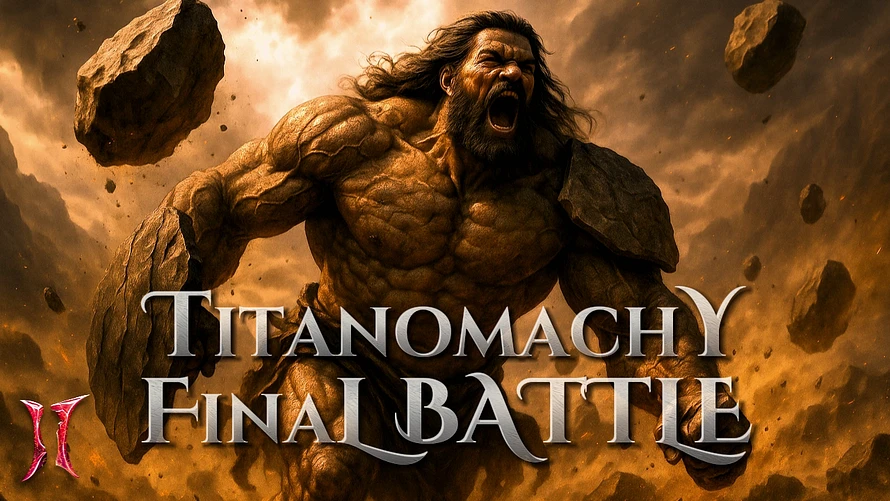
On the second war for the sky
There is a particular kind of silence that comes after the first clash.
Not peace. Not yet.
Imagine the world holding its breath. Stones still humming from impact, air still tasting of ash and ozone, the sea pretending to be calm while it coils itself for later. Olympus and Othrys, two mountains facing each other like clenched fists, both suddenly still.
That is where this episode lives: in the space between one impossible battle and the next, when everyone knows there will not be a third.
Children Who Refuse To Be Devoured
Before you see a single bolt fly, this war is already about memory.
Cronus belongs to an older pattern. He did what his father did, only louder. Cut the sky, took the throne, swallowed his children before they could grow teeth. That was his version of safety: no heirs, no threat.
Zeus and his siblings are not saints. They are dangerous, volatile, young. But they are very clear on one thing: they refuse to become a copy of the previous age.
Around Hestia’s small, stubborn flame, you can almost hear the unspoken rule passing from hand to hand: no more swallowed siblings. No more children disappearing into the dark because a parent is afraid of the future.
The war becomes less about who sits on the throne and more about breaking that one habit of the cosmos. Devouring ends here, or the whole cycle is pointless.
Strategy, Not Rage
When people think of the Titanomachy, they usually imagine one thing: chaos. Giants hurling mountains, Titans tearing up the horizon, Zeus throwing lightning like a storm that learned how to walk.
What interests me more is the rhythm underneath all that noise.
On one side, you have the raw, old power of the Titans. They are used to shattering obstacles, not solving them. When Palas, the Titan strategist, steps forward with a plan, his answer is still force, just rearranged: one overwhelming charge, one brutal punch to break the gods’ careful pattern.
On the other side, the young gods are learning something the old order never bothered with: coordination.
Poseidon does not just summon waves to drown everything. He spends time carving the battlefield itself, drawing trenches and channels like a map only he can read. Hades moves through tunnels and dreams, turning fear into a weapon long before his enemies see his face. Hera stands above it all, not in a chariot, but over a table full of maps, adjusting positions by the width of a hill or the angle of a wind.
The Hecatoncheires throw mountains not at random, but with timing. The Cyclopes forge a single bolt with the weight of a whole age inside it. Even Demeter, far from the front lines, is part of the strategy. She builds a sanctuary for the wounded so the war does not eat everything that gives life its meaning.
The old world thinks in blows.
The new world thinks in patterns.
The Moment When Time Falters
Every generational story has the same question hiding underneath the spectacle. At what point do you stop being the rebel and become the ruler you once opposed?
For Zeus, that hinge is his father’s body.
There is a moment when he stands with the final thunderbolt still warm in his hand, watching Cronus across the battlefield. This is not a clean, heroic frame. Cronus is not just a villain; he is also the shape of Zeus’s worst possible future. The devourer who did not know when to stop.
When the bolt finally flies, it is not just an act of aggression. It is a verdict on an entire way of holding power. The scythe that once cut open the sky is shattered by something new: a weapon built not only from fire and metal, but from memory and outrage and the names of everyone who disappeared down his throat.
Time wavers. The father falls. For a heartbeat, the cosmos does not know who it belongs to.
What I like about this telling is that Zeus does not get an easy victory lap. He wins a throne and inherits a problem. He now has to prove, over centuries, that he will not become the same threat in a different cloak.
Atlas And The Cost Of Standing On The Wrong Side
Punishment in myth is almost never subtle. Snakes, boulders, eternal fires. Suffering that announces itself from miles away.
Atlas is different.
He is not the loudest Titan. He is not the most cruel. He is simply the one who stood firm on the wrong side, with all his strength and all his discipline, at the exact moment the world needed him to bend.
His sentence is strange and almost quiet: he ends up holding the sky.
No chains, no pit, no triumphant speech. Just a weight that settles on his shoulders and never leaves. The heavens themselves pressing down. Stars across his back. Clouds brushing his cheek like sweat.
There is something almost tender in that image. Atlas becomes a living hinge between the world that was and the world that will be. Every time the sky looks stable, you are really seeing one Titan who will never again walk away.
In a story that is full of explosions and roaring giants, his punishment is one of the most haunting. It is the price of lending your strength to a doomed order and discovering that, instead of dying with it, you have to hold up what comes after.
Gaia’s Silence Is Not Peace
It would be so tempting to end the war and wrap everything up with a neat bow.
The tyrant falls. The brothers divide the sky, sea and underworld. Neutral powers keep their spheres. The pit closes over the defeated Titans. The gods swear oaths about law and memory and how they will never repeat the old cruelties.
The camera could fade out there.
But the earth is listening.
Gaia has already watched one husband overthrown, then a son repeat the same horror in a different key. She has given her support to revolution twice and watched it harden into throne and prison bars both times. You can feel her drawing back, roots curling inward, mountains thinking dark thoughts.
Her silence at the end of the war is heavy. It is not approval. It is the kind of quiet that comes before an earthquake.
Somewhere in that silence, something is taking shape. A response that does not look like a council or a pact, but like a storm with a face. The gods think they have finished a cycle. Gaia knows they have only finished a chapter.
After The Thunder
When the smoke clears and the last stones stop rolling, what remains is not just a new political map of the cosmos. What remains is a promise.
No more devourers.
No more children swallowed out of fear of their future power.
The war of Titans and gods becomes a story about that promise being made under pressure, with mud on everyone’s feet and ichor drying on the ground. It is not clean. It is not pure. It is still a world of weapons and pits and punishments that last longer than mountains.
But it is a turn.
In the full episode, we stay with that turn for longer than usual. We walk through the sanctuary where Demeter tries to keep life from collapsing. We watch Hera’s command change from battlefield formations to the first outlines of law. We see Hades, no longer just the shadow in tunnels, step into the role that will define him. We follow Atlas to the edge of the world and watch the sky settle, inch by inch, onto his shoulders.
And somewhere far below, Gaia begins to brood. The next threat is already stirring. Typhon is not on stage yet, but you can feel the script making space for him.
If you want to sit inside that silence between storms and hear the thunder roll in for yourself, the complete story is waiting for you on the YouTube channel and in the podcast feed.
🎬 VIDEO
https://youtu.be/BDhfeRVsHbg
🎧 PODCAST
https://open.spotify.com/episode/6rjdUARXxlxd9Q14Xcuy5n?si=HmbKiS4KS4CQMxCHQyvLNA