S1•E6 | Definitive Greek Mythology Series
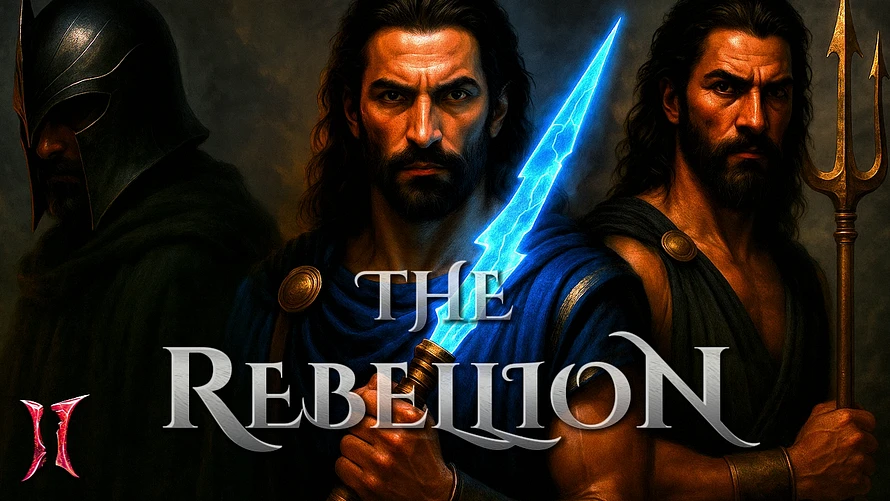
On the night before a god declares war on his own bloodline, there is no glory. There is a boy who cannot sleep.
He is called Zeus. Someday, the stories will dress him in gold and thunder and call him King of the Gods. But before that, there is just a young man lying awake, replaying a story he was never supposed to survive: a father who eats his children to keep a prophecy from coming true, a mother who hides one infant in a cave and sends a stone instead.
That boy is the stone that refused to stay in his father’s stomach.
This episode sits with him there, in that in-between place, before the first bolt is thrown.
A child born under a sentence
Zeus grows up with a prophecy hanging over his head like a second sky: one day, a child will end Cronus.
He didn’t hear it from an oracle. He heard it in fragments, around fires, in half-whispers between gods who still flinch when a shadow moves the wrong way. He grew up with the knowledge that his father swallowed his siblings whole, and that he survived only because his mother decided to cheat destiny with a rock wrapped in cloth.
You can feel how wrong it is in the way he carries himself. He’s not the relaxed, arrogant Zeus of later myths yet. He’s still the kid who knows he should not exist and yet does. The one whom destiny points at with an accusing finger.
When the episode opens, his nightmares are already old. He dreams of teeth, of darkness, of being pressed down into the acid of Cronus’ stomach with the rest of his siblings. The memory is not fully his, but trauma doesn’t care about technicalities. It passes down like eye color.
Zeus wakes up over and over with thunder under his skin and one question he cannot get rid of: if I was born to end my father, what does that make me?
Olympus built on swallowed years
We like to picture Olympus as this shining, perfect palace in the clouds. In S1E6, it feels more like a house built over a crime scene.
Zeus, Poseidon, Hades, Hestia, Demeter, Hera. They are together now, freed from their father’s body. But every shared meal carries the memory of being shared prison. Every laugh is a little too sharp at the edges.
Zeus is technically the youngest. The baby that never got swallowed. But emotionally he becomes the center of their orbit, the one everyone keeps looking at when they talk about “what comes next”.
There’s a quiet scene where that weight becomes visible. A look from Poseidon that is half brotherly pride, half worry. Hades watching Zeus like someone who knows that power always asks for payment. The sisters remembering the sensation of sliding back into the light and seeing this boy waiting for them as if he had always been there.
They trust him because they have no one else to trust. They resent him just a little because he never tasted what they tasted. Both feelings sit in the room at the same time, crackling like static.
And behind all of it, Cronus still reigns. The world outside Olympus still bends its knee to the titan who devours the future to stay in control.
Zeus realizes that as long as Cronus sits on the throne, their survival is only a pause between bites.
Descent into the forgotten
Every mythic revolution needs a moment of descent. Not into metaphor, but literally down.
Zeus chooses to go where no one wants to look: Tartarus. The place where the “monsters” were chained long before he was born. Creatures so dangerous that even Cronus keeps them buried under layers of sky and stone.
Cyclopes. Hecatoncheires. Names that, in most retellings, get flattened into boss battles or background noise. Here, they are people who were punished for existing in a shape that didn’t fit the first king’s idea of order.
Zeus goes down to them not as a conqueror but as someone who knows what it means to be swallowed for being inconvenient to a prophecy.
The episode lingers on their first meeting. The awkward silence. Zeus trying not to flinch at the sight of a hundred hands or a single burning eye. The way they study him in return, weighing whether this skinny god with shaking fingers is the one they want to bet their freedom on.
He offers them something dangerous: a chance at revenge and a place in the new world he wants to build. In return, they offer him something equally dangerous.
Not just weapons. Witnesses.
They tell him how Uranus ruled. How Cronus overthrew his own father and then remade the same cage in a different metal. Zeus hears his potential future described in someone else’s past.
It is the most frightening thing anyone could give him.
The shape of a thunderbolt
Of course they forge the famous weapons. The Cyclopes do what Cyclopes do.
A thunderbolt for Zeus. A trident for Poseidon. A helm of darkness for Hades.
Most versions stop there, listing the items like loot drops. In this episode, the forging feels almost sacred, and a little horrifying. These are not toys. They are extensions of fear and hope, hammered into metal.
The Cyclopes look at Zeus and ask a question no one has dared to ask him on Olympus: what do you want to be when you win?
He doesn’t have a clean answer. How could he? He wants Cronus gone. He wants his siblings safe. He wants a world where no one has to hide their children in caves. But under all that, the thirst for power is real. The script doesn’t pretend otherwise.
So they build the thunderbolt to hurt, yes, but also to remind. The way it’s described on the page, lightning becomes a kind of violent clarity. Every time Zeus throws it, he will remember that he owes his strength to those who were buried before him.
The weapon is not just a symbol of dominance. It’s a debt. A promise. A warning.
Standing on the edge of Titanomachy
When Zeus climbs back toward the light, he is not the same god who went down.
He carries new weapons, yes, but more importantly he carries new eyes. He has seen what happens when someone uses revolution as an excuse to install themselves as a slightly prettier tyrant. He knows now that the prophecy about him is only half the story. The other half will be written by the choices he makes after Cronus falls.
Back on Olympus, he lays everything out for his siblings. The truth about Tartarus. The allies he has brought. The war he wants to start.
You can feel the room tilt.
Some of them are ready to burn the world down if it means never seeing their father’s shadow again. Some of them are terrified of swapping one nightmare for another wearing Zeus’s face. All of them understand that once the first thunderbolt flies, there is no undoing it.
The episode stops right there, on that ledge. Everyone watching Zeus, waiting for him to become the prophecy or to break it.
No Titanomachy yet. Just the breath before.
We already know, from distant schoolbook versions of the myth, that Zeus will end up king. But this episode refuses to rush to the coronation. It stays in the uncomfortable, human space where the outcome is still foggy and the hero is still unformed, trembling, capable of becoming either liberator or copy of his father.
If you want to see that moment stretched out and lit from the inside, the full episode is waiting.
Watch “The Rise of Zeus” on YouTube, or listen to it as a podcast, and let yourself sit with him there, just before the sky breaks open.
🎬 VIDEO
S1•E6 | Definitive Greek Mythology Series