S1•E4 | Definitive Greek Mythology Series
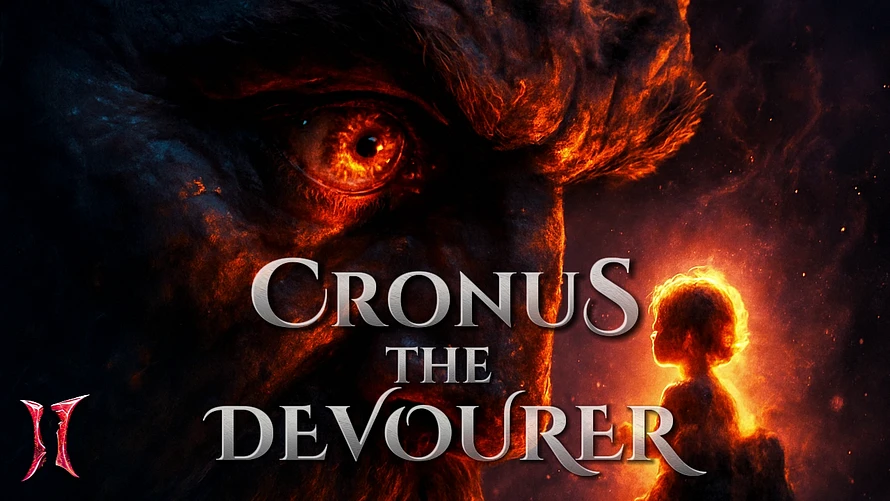
A god who eats the future to sleep at night
The sky has already been cut open when we arrive.
The blood of Uranos has cooled; the scream of a fallen heaven has faded into a dull echo in the stars. On Mount Othrys, in a hall made of night and stone, Cronos sits on a throne of cosmic obsidian with the sickle across his knees. The same blade that once shook in his hand when he raised it against his father now lies quiet, like a memory that refuses to die.
Light moves differently around him. It doesn’t simply shine. It flinches.
This episode is not about the rebellion that crowned him. It’s about what happens after victory, when the hero of one age slowly realizes he may be the villain of the next. When the god of time discovers that the future has teeth.
A throne built on a whisper
Cronos is not introduced as a roaring conqueror. By the time we meet him, the revolt is done. Uranos has fallen. The sky has been opened like a wound. The Titans have taken their places.
And yet the first thing that really matters is a sound: a voice that is no longer there, but still laced through the cosmos.
The curse of Uranos.
One day, a child of your own blood will rise and do to you what you did to me.
It’s not shouted. It’s not some formal prophecy delivered with ritual and fanfare. It’s more like a bruise in the fabric of space. A memory carved into the stars. Cronos hears it, and the blade that once made him feel powerful suddenly feels heavier on his lap.
From that moment on, his throne is not made only of stone and darkness. It is built on the constant whisper that he will fall. That he will be replaced. That time itself, which he believes he controls, is quietly counting against him.
The silence after rebellion
The throne room on Mount Othrys is full, but it feels empty.
Twelve Titans gather around Cronos, each of them a walking element. Sun, sea, memory, the architecture of the sky. They are enormous, radiant, draped in cosmic forces that should make them terrifying. Instead, they bow.
Not with love. Not with joy that the old tyrant is gone and a new age has begun. Their devotion trembles at the edges. Their eyes flicker with something small and very human: fear.
Cronos knows the difference.
He looks out at his court and senses it all at once. This is not loyalty. This is people trying not to become a problem. The same way he once watched Uranos, they now watch him. Measuring his moods. Weighing his silences. Waiting to see whether the hand on the sickle trembles.
Rebellion promised freedom, but what he has built is a kingdom made of held breath.
It’s a chilling kind of symmetry. He has become the thing he destroyed, without even meaning to. And because he knows how revolutions are born, he sees them everywhere. In the corner of a Titan’s eye. In the tilt of a head. In the shadows that move where they shouldn’t.
The enemy is no longer outside the palace. It’s inside his own future.
Mothers under a devouring sky
There is another story running parallel to Cronos’ paranoia, and it does not begin with triumph. It begins with the body.
Rhea.
She arrives not as an abstract title - not just “queen” or “consort” - but as a presence that bends the silence of the hall. Moonlit robes, crescents in her hair, an aura that smells like new worlds. There is a tenderness in her that doesn’t fit this throne room full of blades and curses.
Standing not far from her is Gaia, the earth itself, rising from cracks in the cosmic floor. No longer crying beneath Uranos’ weight, she moves now with the slow certainty of mountains. Mothers of different ages: one who has seen everything, one who is about to lose everything.
Between them, a quiet alliance begins to form. Not with speeches. With looks. With the way Gaia’s hand lingers on Rhea’s cheek, leaving the faint impression of leaves and stone. With the way the two of them stand slightly apart from Cronos’ shadow, as if already preparing for a world after him.
Cronos has his sickle and his throne. They have something else: the stubborn instinct to protect whatever is still small and unfinished in a universe ruled by fear.
It’s the most dangerous force in the room.
The taste of children
The horror doesn’t arrive all at once. It comes in cycles.
First, the glow of birth. Hestia, tiny and crowned in flame; the warmth of the hearth condensed into an infant’s body. Then Demeter, smelling of grain and harvest. Hera, haloed in the perfume of sovereignty. Later, the dark-eyed weight of Hades; the restless tide in Poseidon.
Each child feels like a new world stepping to the edge of existence, ready to speak.
Every time, for a single heartbeat, Rhea believes this one might be different. That Cronos will look into this face and see not a threat, but a child. That the prophecy will loosen its hold for just a moment and let her keep what she has created.
He never does.
Cronos takes them. Not with wild rage, but with a cold, almost ritual certainty. He devours them and swallows the evidence. The universe shudders, goes quiet again. Another future disappears into his body.
This is the real core of the episode: a god who is so afraid of being replaced that he literally eats his own future. He tries to outrun the prophecy by folding it into himself, turning his insides into a prison of unborn gods.
On the outside, his throne grows taller. On the inside, his fear grows claws.
And Rhea learns to cry without sound.
A stone in place of a son
Tyranny never really notices the moment it goes too far. Mothers do.
By the time we reach the next birth, Rhea is no longer just grieving. She is listening. To Gaia’s quiet counsel. To the tiny shift in the cosmos that says: this pattern cannot continue forever. Something is going to break.
When Zeus is born, it doesn’t happen on full display, in the center of the throne room. It happens in the folds of shadow, in secret hollows of the universe where Cronos’ gaze cannot reach. The child arrives wrapped in darkness and lightning, already carrying the suggestion of storms.
Rhea holds him, and for once, she does not hand him over.
Instead, she and Gaia prepare something else for Cronos’ hunger: a stone shaped into perfection, the Omphalos. It is heavy, pulsing with false promise, wrapped in cloth like a newborn. A decoy swaddled as destiny.
The exchange is almost quiet. Rhea approaches the throne. Cronos feels the weight in his hands. There is a brief, strange pause, the kind of moment that in another life might have become mercy. It passes. He swallows.
The hall goes dark, then bright again. The universe recalibrates around a lie.
Far away, unseen, a real child breathes.
When time looks over its shoulder
At the edges of all this, there is another presence. Not at the center of the scene yet, not fully in the light.
Metis.
She is hinted at like a shadow moving behind the curtain of fate - a mind that watches, learns, waits. She is not the one who hides the baby this time. She is not the savior of Zeus’ infancy. Not yet. But she feels the disturbance: a stone swallowed instead of a son, a prophecy slightly out of alignment.
You can almost feel her pause, somewhere far from Mount Othrys, as if the web she’s been studying has developed a new knot.
The episode closes with that sense of unfinished business.
Cronos still sits on his throne. He still holds his sickle, still carries a universe of stolen children inside him. The Titans still bow. Rhea still walks the halls with empty arms, except for one secret that beats in the dark. Gaia sinks back into the earth, carrying her plans like seeds.
And somewhere out in the cosmic quiet, Metis disappears deeper into the shadows, already thinking about how to help time’s devourer choke on his own fear.
A curtain that doesn’t quite close
This is not the story of Cronos’ fall. Not yet.
It is the slow tightening of a noose he cannot see, woven from grief, prophecy, and the kind of stubborn love that keeps creating life even in the mouth of a monster. It is a portrait of a god who won the war against his father, only to lose the one against himself.
The age of Cronos is an age that pretends to be stable but hums with dread under the surface. A throne built on devoured possibilities. A mother hiding one last heartbeat. A stone sitting where a god should be.
The storm hasn’t broken. You just feel the air changing.
If you want to step fully into this world - to see the obsidian throne, hear the silence in the hall, watch the Omphalos disappear into the tyrant’s mouth - the full cinematic retelling of this episode is waiting for you on YouTube. And if you prefer to walk through myths with your eyes closed, carried only by voice and sound, the story also lives in the podcast feed.
🎬 VIDEO
S1•E4 | Definitive Greek Mythology Series